Minnesota P&C Insurance Exam Cheat Sheet
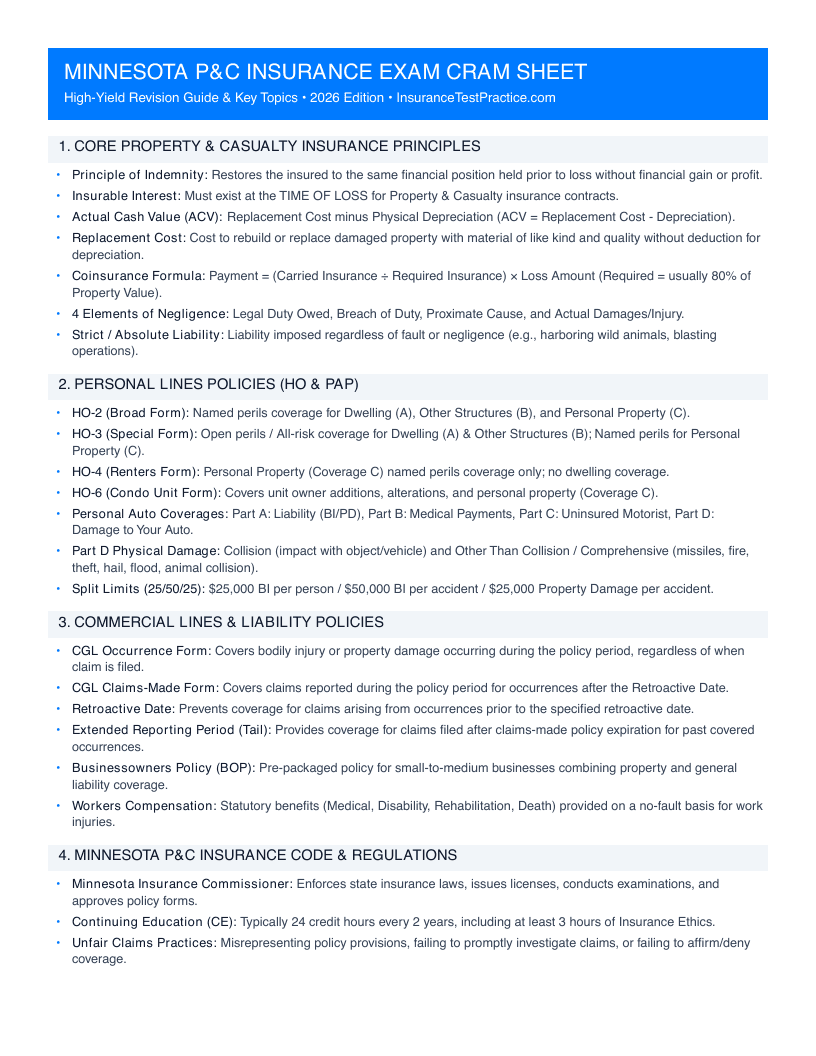
Unlock the official Minnesota Property & Casualty exam cram sheet to master key state regulations, policy definitions, and exam-day metrics. Or, start with our free Minnesota practice questions to test your knowledge.
What's Covered on the Minnesota Property & Casualty Exam
Key exam lines — know what each one tests
Property Insurance Line
- Homeowners policy forms (HO-2, HO-3, HO-4, HO-6)
- Dwelling policies (DP-1 basic, DP-2 broad, DP-3 special)
- Commercial Property & Inland Marine equipment floaters
- Valuation rules: Actual Cash Value (ACV) vs Replacement Cost
- Coinsurance clauses, deductibles & subrogation
- State FAIR Plan & Insurance Code property provisions
Casualty Insurance Line
- Personal Auto Policy (PAP) liability limits & physical damage
- Financial Responsibility Laws & CAARP risk plan
- Commercial General Liability (CGL) occurrence vs claims-made
- Businessowners Policy (BOP) & Commercial Package Policy (CPP)
- Workers' Compensation law & Employer Liability coverages
- Personal & Commercial Umbrella Liability insurance
Download Your Free Minnesota Cram Sheet
A 2-page PDF packed with the highest-yield facts for the Minnesota Property & Casualty licensing exam. Enter your email to get instant access.
Get the Free PDF
Instant download, no spam
Frequently Asked Questions
Q:What topics are on the Minnesota Property & Casualty insurance exam cheat sheet?
The Minnesota P&C cheat sheet covers the major exam topics: personal auto policy (PAP) coverage parts and exclusions, homeowners policy forms (HO-2 through HO-8), dwelling policies (DP-1/DP-2/DP-3), commercial general liability (CGL) including occurrence vs claims-made forms, businessowners policies (BOP), workers compensation, Minnesota Insurance Code requirements, cancellation/nonrenewal rules, and anti-fraud regulations.
Q:How many questions are on the Minnesota Property & Casualty insurance exam?
The Minnesota P&C licensing exam typically has 150 multiple-choice questions (some states offer separate Property-only and Casualty-only exams of 75 questions each). A passing score of at least 70% is generally required. Check with Minnesota's insurance department for the most current exam specifications.
Q:What is the difference between occurrence and claims-made CGL policies?
An occurrence CGL policy covers claims arising from incidents that occurred during the policy period, regardless of when the claim is filed. A claims-made policy covers claims both reported AND occurring during the policy period (subject to a retroactive date). Claims-made policies often require an Extended Reporting Period (ERP/tail coverage) after the policy ends.
Q:What homeowners forms are tested on the Minnesota P&C exam?
The exam tests all standard HO forms: HO-2 (Broad Form — named perils), HO-3 (Special Form — open perils on dwelling, named perils on contents), HO-4 (Renters/Contents Broad Form), HO-5 (Comprehensive Form — open perils on both), HO-6 (Condo Unit Owners), and HO-8 (Modified Coverage for older homes). HO-3 is the most commonly tested form.
Q:How do I use this Minnesota P&C cheat sheet to study?
Use this cheat sheet as a quick reference during the final days before your exam. Focus on the policy form comparison tables, coverage limits, and Minnesota-specific regulations. Pair it with full-length practice tests to identify your weak areas, then return to the cheat sheet to reinforce the concepts you missed.
Q:What are the key Minnesota Insurance Code topics for the P&C exam?
Minnesota-specific P&C exam topics include: mandatory auto liability minimum limits, FAIR plan and assigned risk pool eligibility, cancellation and nonrenewal notice requirements, anti-fraud provisions, producer licensing requirements, and unfair trade practices. These state-law questions typically account for 15–20% of exam questions.