Hawaii Insurance Exam Cheat Sheet
Unlock the official Hawaii Life & Health exam cram sheet to master key state regulations, policy definitions, and exam-day metrics. Or, start with our free Hawaii practice questions to test your knowledge.
What's Covered on the Hawaii Life & Health Exam
Key exam lines — know what each one tests
Life Insurance Line
- Term, Whole, Universal & Variable Life policies
- Annuities (fixed, variable, immediate, deferred)
- Beneficiary designations & settlement options
- Policy riders: waiver of premium, AD&D, COLA
- Replacement rules & suitability requirements
- Grace period: 30–31 days | Free-look: 10 Days (30 Days)
Health Insurance Line
- Individual & group health, HMO, PPO, EPO, POS plans
- Medicare Parts A, B, C, D & Medigap supplements
- Medicaid & CHIP eligibility rules
- COBRA, HIPAA, ACA & continuation provisions
- Disability income: STD & LTD elimination periods
- Grace periods: 7 / 10 / 31 days by premium mode
Download Your Free Hawaii Cram Sheet
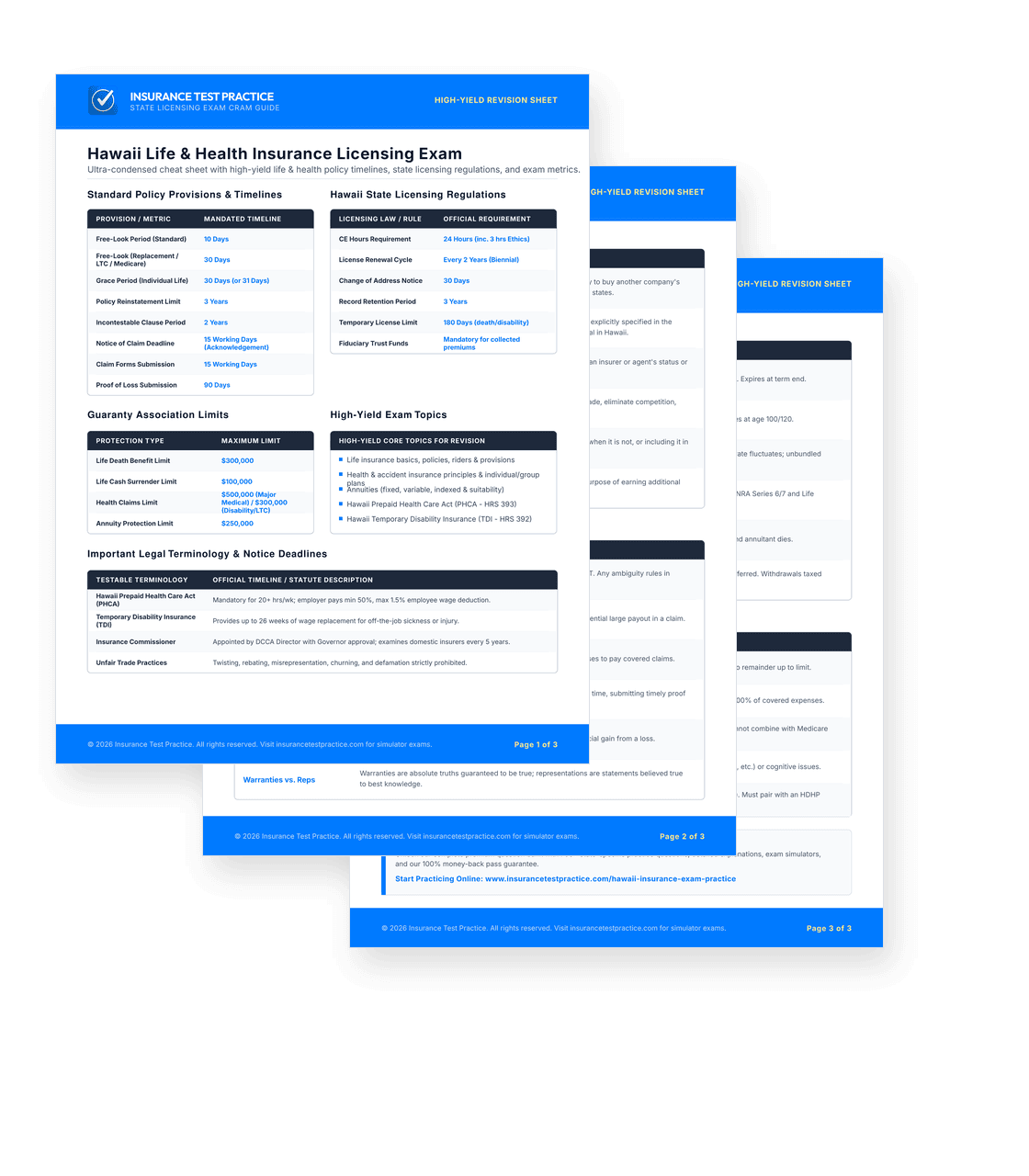
A 3-page PDF packed with the highest-yield facts for the Hawaii Life & Health licensing exam. Enter your email to get instant access.
Get the Free PDF
Instant download, no spam
Frequently Asked Questions
Q:How do I pass the Hawaii Life, Accident & Health insurance exam on my first try?
To pass the Hawaii Life & Health licensing exam on your first attempt, follow a structured preparation strategy: First, thoroughly master core national insurance products — term and permanent life, major medical, disability income, Medicare supplement, and annuities. Second, dedicate focused study time to Hawaii-specific statutory mandates under HRS Title 24, including the Hawaii Prepaid Health Care Act (PHHawaii), Temporary Disability Insurance (TDI), DCHawaii producer licensing regulations, 30-day replacement free-look rules, and Guaranty Association limits. Third, complete at least 300+ scenario-based practice questions and timed mock exams until you consistently score 80% or higher, well above Hawaii's 70% passing threshold.
Q:How many questions are on the Hawaii Life & Health exam and what is the passing score?
The combined Hawaii Life, Accident and Health insurance examination administered by Pearson VUE contains approximately 150 multiple-choice questions (including unscored pretest items) with a 2-hour and 30-minute (150 minutes) time limit. To pass, you must achieve a scaled score of at least 70%. Single-line Life-Only and Accident/Health-Only exams (~75 questions, 105 minutes) are also available for candidates pursuing single-line licensing.
Q:What unique Hawaii statutes and mandates are tested on the exam?
The exam heavily tests Hawaii's unique social insurance and health statutes: (1) The Hawaii Prepaid Health Care Act (PHHawaii, HRS Chapter 393), requiring employers to provide medical coverage to employees working 20+ hours/week for 4 consecutive weeks; (2) Hawaii Temporary Disability Insurance (TDI, HRS Chapter 392), providing mandatory wage replacement for off-the-job illness/injury; and (3) DCHawaii Insurance Division regulations covering producer licensing, 24-hour biennial CE (3 ethics), 3-year record retention, unfair trade practices, and the Hawaii Life and Disability Insurance Guaranty Association.
Q:How much does the Hawaii insurance exam cost and where can I take it?
The Hawaii insurance examination fee is $75 per attempt, payable directly to Pearson VUE when scheduling. Examinations are administered at authorized Pearson VUE test centers in Hawaii (including Honolulu on Oahu, Hilo and Kailua-Kona on Hawaii Island, Kahului on Maui, and Lihue on Kauai) as well as via Pearson VUE OnVUE remotely proctored online testing. You can register and schedule online through the Pearson VUE Hawaii Insurance portal (home.pearsonvue.com/hi/insurance). On exam day, you must present two forms of valid, unexpired identification (one government-issued photo ID).
Q:What are the licensing steps and pre-licensing education requirements in Hawaii?
Hawaii does not mandate statutory classroom pre-licensing education hours (self-study is permitted). To obtain a resident producer license, you must: (1) be at least 18 years of age and a Hawaii resident, (2) pass the Pearson VUE licensing examination with a score of 70% or higher, (3) submit digital fingerprints for criminal background checks through Fieldprint Hawaii ($50 fee), and (4) submit your official resident producer application electronically via NIPR (nipr.com) with the Hawaii Insurance Division licensing fee.
Q:What is the retake policy and continuing education requirement in Hawaii?
If you do not pass the Hawaii examination, Pearson VUE will provide a diagnostic score report breaking down your performance across each domain. You can reschedule through Pearson VUE as soon as testing appointments are open; the full $75 fee applies for each attempt. Once licensed, Hawaii resident producers must complete 24 hours of approved Continuing Education (CE) every two years prior to their biennial license renewal date, including at least 3 hours in approved Insurance Ethics.