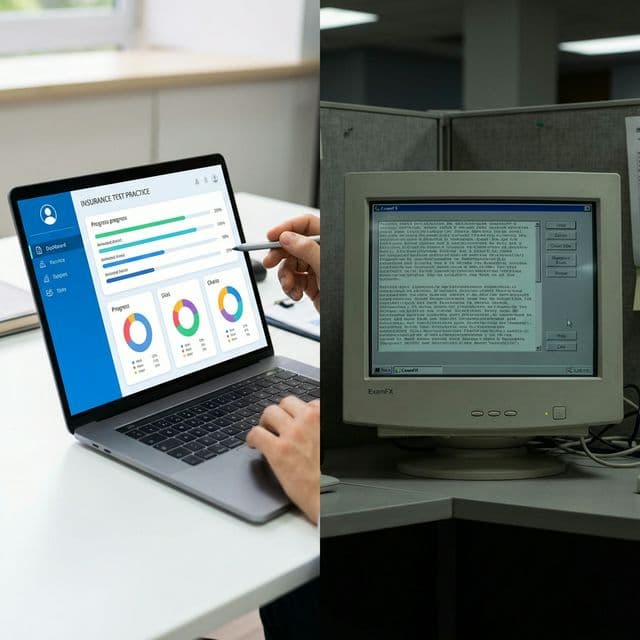
If you're studying for a life and health insurance licensing exam, you've probably come across two names over and over again: ExamFX and InsuranceTestPractice.com. Both promise to help you pass. Both have thousands of practice questions. And both show up on the first page of Google when you search for insurance exam prep.
So which one should you actually spend your money on?
We've spent time with both platforms, talked to students who've used each, and dug into the details that most review sites gloss over. Here's what we found.
The Short Answer
If you want a traditional, textbook-style course with video lectures and you don't mind paying $150–$300+, ExamFX is a solid legacy option. It's been around for years and many people have passed using it.
But if you want a modern, focused, and affordable way to prepare — one that zeroes in on your specific state's exam content and lets you practice with questions that actually mirror what you'll see on test day — InsuranceTestPractice is the better choice. It's what we'd recommend to anyone taking the exam in 2026.
Now let's get into the details.
Study Experience: Textbook vs. Active Practice
The first thing you'll notice when you open ExamFX is that it feels like an online textbook. There are long chapters of reading material, video lectures you're expected to watch from start to finish, and quizzes at the end of each section. It's the same format that online courses have used for the last decade. For some learners — especially those who prefer to read through material linearly — this works fine.
The problem is that most people don't study that way anymore. Research on active recall and spaced repetition has shown that practicing with questions is far more effective than passively reading content. You learn insurance concepts faster by testing yourself on them repeatedly, not by highlighting paragraphs in a digital textbook.
InsuranceTestPractice was built around this principle. Instead of burying you in reading material, it puts practice questions front and center. Every question comes with a detailed explanation of the correct answer, so you're learning as you go. The interface is clean, fast, and designed for the way people actually study in 2026 — in focused 15–20 minute sessions on their phone or laptop, not hour-long textbook marathons.
ExamFX also has practice questions, of course. But they often feel like an afterthought — something you do after you've finished the "real" studying. On InsuranceTestPractice, the questions are the studying.
Question Quality: Generic vs. State-Specific
This is the biggest difference between the two platforms, and it's the one that matters most on exam day.
ExamFX uses a largely generic question bank. Many of the same questions appear regardless of which state you're preparing for. While the core insurance concepts are the same everywhere, state-specific regulations, laws, and requirements make up a significant portion of most licensing exams. If you're studying for the California exam, you need to know California's specific insurance code, not just general national insurance principles.
InsuranceTestPractice takes the opposite approach. Every question bank is built around a specific state's exam content outline. When you select Florida, you get questions about Florida insurance regulations, Florida consumer protection laws, and the specific topics that the Florida Department of Financial Services tests on. The same goes for California, Texas, New York, and every other state.
This matters more than most people realize. Students who use generic prep material often walk into their exam and encounter questions about state-specific rules they've never seen before. That's not a knowledge gap — it's a prep material gap. And it's completely avoidable.
Content Updates: How Current Is the Material?
Insurance regulations change. States update their exam content outlines. New laws get passed. If your study material is based on last year's exam outline, you could be studying the wrong things.
ExamFX typically updates their content on a yearly cycle. That means for parts of the year, their material may lag behind the latest exam changes. It's not a dealbreaker, but it's worth knowing.
InsuranceTestPractice updates its question banks on a weekly basis. When a state updates its exam content outline or changes a regulation, those changes are reflected in the practice questions within days, not months. For an exam where the difference between passing and failing can come down to a handful of questions, having current material gives you a real edge.
Pricing: What You're Actually Paying For
Let's talk about money, because the price difference is significant.
ExamFX charges between $149 and $300+ depending on the package you choose. Their basic package gets you the online course. Their premium packages add practice exams, flashcards, and a guarantee. If you want the full experience, you're looking at the higher end of that range. And if you're preparing for exams in multiple states, you'll need to buy separate courses for each one.
InsuranceTestPractice uses an affordable subscription model. You get access to all states, all question banks, flashcards, mock exams, and detailed explanations — everything — for a fraction of what ExamFX charges for a single state. There are no upsells, no "premium tiers" that lock essential features behind a paywall. You get everything from day one.
When you factor in the cost of retaking the exam if you fail (which ranges from $40–$80+ depending on your state, plus the time you lose), the value proposition becomes even clearer. Spending less on better-targeted prep material is just smart math.
Pass Guarantee
Both platforms offer some form of pass guarantee, but the details differ.
ExamFX's guarantee comes with conditions. You typically need to complete a certain percentage of the course, pass their internal practice exams with a minimum score, and meet other requirements before you qualify. If you don't check every box, the guarantee doesn't apply.
InsuranceTestPractice offers a straightforward 100% money-back guarantee. If you use the platform and don't pass your exam, you get your money back. No complicated conditions, no fine print hoops to jump through. It's a simple promise: we help you pass, or you don't pay.
Mobile Experience
A surprising number of insurance exam candidates do most of their studying on their phones — during lunch breaks, on the commute, or in bed before sleep. The mobile experience matters.
ExamFX has a mobile-responsive website, but it wasn't designed mobile-first. Long reading passages and video lectures don't translate well to a small screen. Navigation can feel clunky, and the experience often pushes you toward using a desktop.
InsuranceTestPractice was built to work beautifully on any device. The question-based format is naturally suited to mobile — you can knock out 10 practice questions in 5 minutes while waiting for your coffee. The interface adapts to your screen size without sacrificing usability.
Pass Rates: The Numbers
The national average first-time pass rate for insurance licensing exams hovers around 55–60%. That means nearly half of all test-takers fail on their first attempt. Both platforms improve those odds significantly, but the gap between them is worth noting.
ExamFX reports strong pass rates, and independent estimates place their users at around 85% — well above the national average. That's a good number, and it reflects the fact that any structured study program is better than studying on your own.
InsuranceTestPractice users pass at a rate of 98%. We attribute this to the combination of state-specific content, active recall methodology, and weekly updates that keep the material aligned with what's actually on the exam. When you practice with questions that closely mirror the real test, you walk in confident — and you walk out with a passing score.
Who Should Use ExamFX?
To be fair, ExamFX isn't a bad product. It's a well-established platform that has helped many people pass their exams. You might prefer ExamFX if:
- You prefer a structured, chapter-by-chapter course format with video lectures
- You learn best by reading through material before testing yourself
- Your employer is paying for your prep course and price isn't a factor
- You want a traditional classroom-style online experience
Who Should Use InsuranceTestPractice?
InsuranceTestPractice is the better fit for most candidates in 2026. You should choose it if:
- You want to focus on practice questions that match your specific state's exam
- You prefer active, hands-on studying over passive reading
- You're on a budget and want the best value for your money
- You study primarily on your phone or in short sessions
- You want a no-strings-attached money-back guarantee
- You need access to multiple states without buying separate courses
The Bottom Line
ExamFX built its reputation in an era when online learning meant watching videos and reading digital textbooks. It's still a functional product, but it hasn't kept pace with how people actually study today.
InsuranceTestPractice was built for the modern exam candidate. It's faster, more focused, more affordable, and backed by a question bank that's tailored to your state's specific exam. The 98% pass rate isn't a marketing number — it's the result of a fundamentally better approach to exam prep.
If you're taking your insurance licensing exam in 2026, don't leave your results to chance. The right prep material is the single biggest factor in whether you pass on your first attempt or spend another $60+ on a retest.
Ready to start studying?
Try InsuranceTestPractice with our money-back guarantee. If you don't pass your exam, you don't pay. It's that simple.
Get Premium Access100% Money-Back Guarantee — No conditions, no fine print.
Recommended Articles
Can You Take the California DMV Permit Test Online? (2026 Update)
Get the latest information about California DMV online permit testing in 2026
How Many Questions to Pass the California Permit Test?
Learn exactly how many questions you need to answer correctly on the California permit test
21 Essential California Permit Concepts
Master the specific laws and rules unique to California driving tests